

Issue #61 – Evolving the Data & AI Maturity Assessment
Even classic approaches get outdated; this is how you need to start thinking about your data & AI maturity

Read Time: 12 minutes
I’m not here to shit on maturity assessments.
They are useful investments of your time, and I usually include one in all of my Data Strategies (I’m actually about to start one with a client).
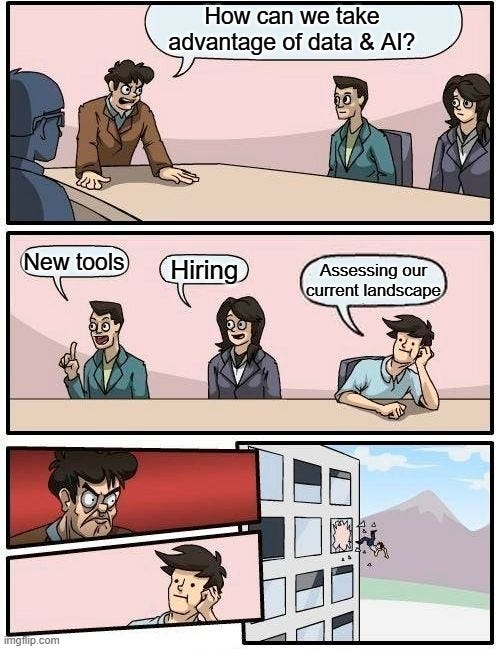
But I’ve come to find that they need to evolve beyond a point-in-time perspective on your data & AI ecosystem; instead, they should be curated to your situation and direction, with actionable outputs at the end.
While that seems obvious, most maturity assessments I see aren’t that. It is usually a consultant walking a leadership team through a lot of 2s and 3s (rarely 4s and never 5s), with widespread alignment—and a bit of resignation—that it will be tough to improve. Then the recommendations follow, which are good, but often not always acted on.
I’m not against this approach, but as I rethink how to deliver strategy in the world of AI, I think a Gartner or DAMA maturity map kind of misses the mark. These approaches to maturity mapping were never designed for the AI world. Nor were they really calibrated to inform decisions.
And the thing about 2026 is that everything has become about AI, and decisions are becoming more immediate. The lines between data and AI are blurring as well; business users are requesting tools, products, and workflows they think AI can deliver with a simple prompt, when in reality, they require a foundational data ecosystem to underpin them.
So the question for your company’s maturity is not “how mature are we?” but “how mature do we need to be to deliver what is expected in today’s world?” And how does AI change that equation?
That’s what I want to work through this week: where the classic assessment falls short, how AI changes both what you assess and what you recommend, and the revamped version I now run (including what a good actually looks like across every data domain I assess).
Generic Maturity Assessments Aren’t Built For Today
If you haven’t seen the standard maturity model, it really isn’t rocket science.
The most common is the 1-5 assessment, starting at Level 1 for ad hoc and reactive capabilities and climbing to Level 5 for optimized and enabling capabilities. To be fair, there are some good ideas in there, but the quality of delivery completely depends on the rigour of the consultant/ employee doing the assessment rather than the framework. The main reason is that the levels describe states of being, not decisions to make.
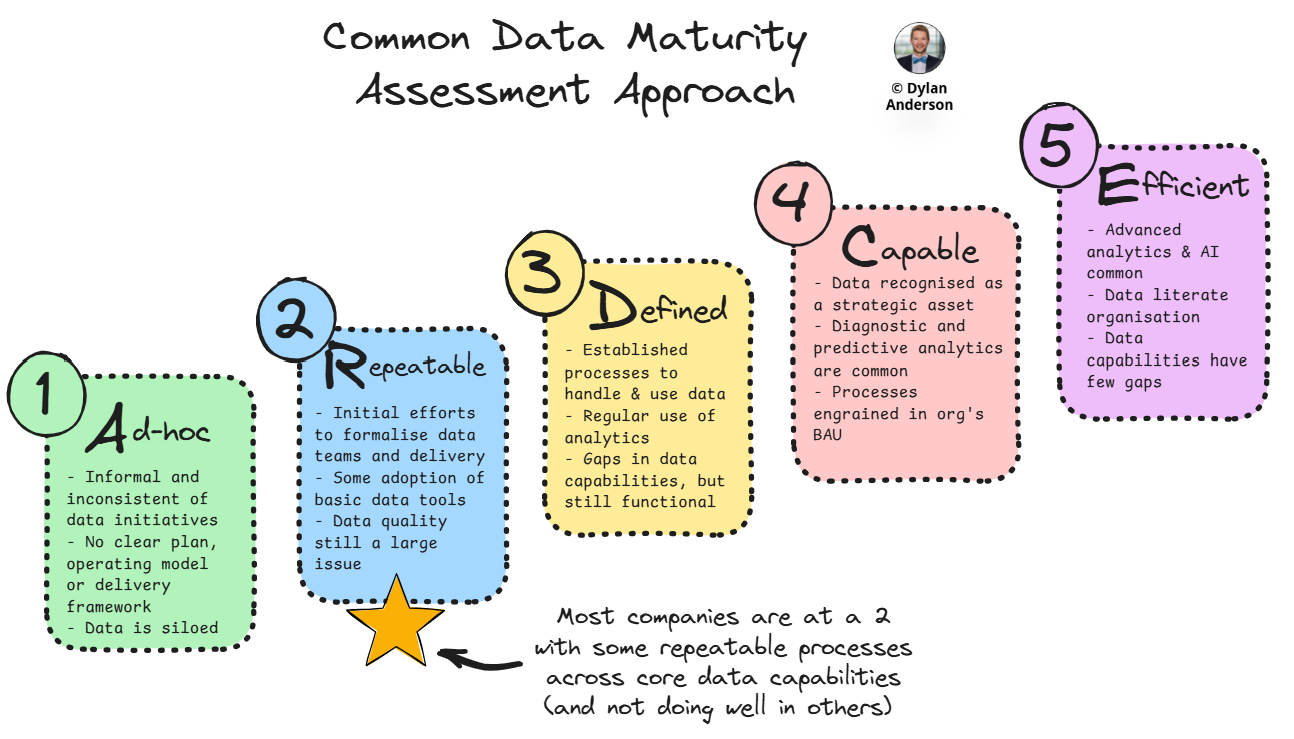
And here’s what actually happens when you run it. Companies usually land at a 1 or 2 for most data domains, which honestly makes it hard to be motivated to drive change. A wall of 2s tells you everything is a problem, which is the same as telling you nothing is a priority.
The deeper issue is what gets scored. The people in the room are ranking the overall enterprise, and the enterprise contains pockets of genuinely good and genuinely bad, smoothed into an average that represents neither.
An enterprise-average maturity score is usually a feeling. But when the score is tied to a specific use case, backed by evidence, you start to see the building blocks for improvement.
This is my first lesson: you need to align the assessment with the organization's specific use cases, goals, and strategic priorities in the data and AI space.
Then you start to back up your scores with specific examples to justify the answer. And that does two things: it makes the score defensible to the exec team and ties the recommendations to real problems. These are two requirements for the eventual funding you need to improve your data & AI maturity.
It also does one other thing I implore everybody to pay attention to: surface dependencies. I dug into this more in the execution half of my data strategy series, but if you aren’t thinking holistically, there will be gaps in how you operate. Data quality, for example, is dependent on data engineering to a degree, so fixing one often moves the other. Approached this way, you can kill two birds with one stone when assessing your data domains.
Maturity in a Cross Human & AI World
I’ll get to how to actually run the assessment in a bit, but in the last year, this whole exercise has changed in my mind.
Of course that’s due to AI, but probably in a different way than you’re thinking.
A typical data maturity assessment already includes a perspective on how mature a company’s AI or data science function is. Every assessment I do has more emphasis on that and I’ve run them with AI engineering or AI governance as part of the larger data domains. This allows for a through-line from data activities and foundations into AI activities and outcomes. Moreover, both have to be tackled holistically against the overall strategy rather than two separate exercises.
Where I’m starting to evolve the maturity assessment, however, is on the recommendation side. We are no longer making recommendations just for humans. We’re making recommendations for AI tooling and AI-embedded workflows as well. That requires a different level of thinking and a different kind of steer from the classic maturity assessment approach.
Think about what a recommendation used to look like: hire these roles, stand up this team, train these people, buy this platform. The maturity evaluated human capability and recommended human change.
Now, half the question is different:
What does it mean to unleash AI tools to remodel our data warehouse?
Or how can AI accelerate requirements gathering?
Should the gap in this domain be closed by people, by an embedded AI workflow, or by a combination where AI does the production and a human owns the output?
I started writing about this redesign question at the systems level in the AI Systems Design series, but the maturity assessment is an easier starting point for companies (i.e., where it gets practical, domain by domain).

So maturity now has to be thought of in both directions: on the inputs (what you assess: human and AI capability in each domain) and on the outcomes (what you recommend: human and AI responses to each gap). And this is how we have to revamp the maturity assessment for today’s world.
The Classic Maturity Assessment, Revamped
Okay, now to put this to the test and explain how to do a data & AI maturity assessment in this way. It’s worth noting I gave a high-level overview of this in my Data Strategy Part 2 article; this is the same approach, just in more detail.

Categorize Your Data Domains – It’s up to you how you group them, but I tend to have four: Business & Data Foundations, Data/AI Engineering & Architecture, Data/AI Management & Governance, and Value Realization & Adoption. Then, based on your own organization and its lexicon, what domains fit within each group, and what are their definitions. I find every organization has a different definition of things and uses slightly different words to describe them. Get this right so everybody is on the same page before anyone scores anything. Half the value of an assessment is agreeing on what exists within the data organization and how people define the domains.
Rank Each Domain – Depending on the effort you want to put in, this step is where you either rank based on interviews or a larger survey. Despite me blasting it above, I typically use the one-to-five approach, one being ad hoc/ initial and five being efficient/ optimized, with written definitions for each level of each domain so the scoring is anchored to something. Quick tip: use AI to help you create those level definitions for each domain with a bit of a view of what good looks like for each one.
Rationalize the Rankings – Provide context as to why your domain was rated that way. Quotes from people are good, as well as triangulating feedback from multiple areas of the business to ensure it is well-rounded, reflective, and you aren’t missing anything. This is also a great spot to find out where things are working and why they are working!
Rate your Ideal Scores – This is the direction, where you want to go from where you are. For each data domain, think about—in a realistic way—where you would like to be in 2 years. You won’t hit 5s or even 4s all over the place, so what is actually required to succeed against your data and AI goals? The gap between current and target is what the strategy, recommendations and action plans build on.
What does good look like?
For your benefit, here are the data domains I usually include and what a 4 looks like in each. The 4 is the most realistic for an ideal/ aspiration, so I wanted to provide the descriptions that may be most relevant.
A couple of things to note:
First, as mentioned above, I’m deliberately co-mingling how the capability appears from both human and AI perspectives, because that’s how it now has to work.
Secondly, these definitions are extremely high-level. I’m not getting into the specifics of each domain because I don’t want this article to take 40 minutes to read. That being said, this gives you a starting point (and you can reach out for me to scope out the rest if you’d like).
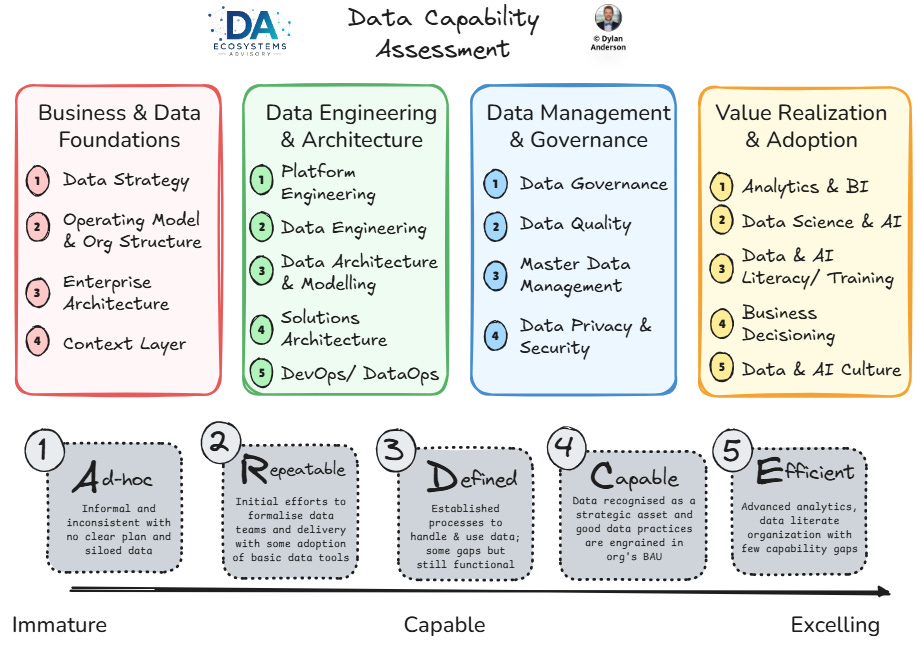
Business & Data Foundations
Data & AI Strategy – A documented strategy exists with clear goals and aspirations for the data & AI initiatives, tying them to business priorities through a prioritized use-case portfolio. Any organizational AI ambitions are underpinned by the right strategic data foundations to ensure scalability and long-term success.
Operating Model & Org Structure – The operating model and org structure define how the data team interacts with business domains, with clear ownership, defined roles, and a stable funding model. Embedded AI workflows and agents are being integrated into the ways of working, with named owners and clear outcomes attached.
Enterprise Architecture – Current-state and target architectures are documented, maintained, and consulted. Systems have owners with known integration patterns, including AI MCPs and interaction points. New AI workflows are guided by enterprise architectural needs rather than on an ad hoc basis.
Context Layer – A context layer is properly embedded in the organization's operational activities. This includes a consolidated and agreed view of business definitions and semantics, with process knowledge and provenance/ audit trail, creating reliability around organizational context. Everything is captured in a way both humans and AI can consume as necessary.
Data/AI Engineering & Architecture
Platform Engineering – A well-functioning platform with managed environments and well-integrated CI/CD. Infrastructure is defined as code, with reusable components that cut cognitive load and stop teams from rebuilding the same scaffolding every time. AI workloads run on the same platform with the same discipline as data workloads, while AI-assisted operations are part of how the platform runs.
Data & AI Engineering – Data pipelines are version-controlled, tested, and monitored, with defined SLAs and a clear path to a solution when something breaks. Failures get caught before the business notices. AI agents and assistants accelerate builds, with a structured approach to agentic development going into production.
Data/AI Architecture & Modelling – Conceptual and logical data models exist, were built with the business, and are kept current as circumstances change. Modelling standards are consistent enough that data from different domains actually joins. AI solutions are built with data architecture and modelling in mind to improve scalability and organization.
Data/AI Management & Governance
Data & AI Governance – Governance has a value-led directive, becoming an embedded part of data & AI delivery. The strategies have been set and aligned to the overall organizational direction. Ownership and stewardship are assigned across data domains and policies are being enforced within the AI, tooling and coding environments, reducing reliance on human oversight.
Data Quality – Data sources have been assessed and quality dimensions are defined for the data that matters. Thresholds, automated monitoring, and issues are routed to accountable owners via a tool or monitoring system. AI flags issues and calls out questionable data so it is not acted on in an error-prone way, with trusted data identified and visibly marked for all users (AI or human).
Master Data Management – Golden records exist for the entities the business runs on (customers, products, suppliers), with clear rules and active stewardship. AI-assisted matching helps maintain them, and downstream systems consume the mastered version instead of maintaining individual versions on their own.
Privacy & Security – Data is classified by sensitivity, and an access management system exists to enforce that classification. AI-specific risks and approaches (e.g., what models can access/ create, audit logging, etc.) are explicitly called out and implemented into the data & AI operations.
Value Realization & Adoption
Analytics & BI – KPIs are standardized across teams, with trusted dashboards allowing for self-serve access for important areas. AI connects to an organized data warehouse/ layer to allow common natural language queries from business stakeholders, instantly identifying answers and drafting commentary for simple questions. Analytics team spends time on deeper level insights.
Data Science / Advanced AI – ML and AI models are run in production with monitoring, drift management, and named owners. They provide genuine business value, whether developing insight or embedded into existing technology. The team has a defined route from experiment to production. Agentic workflows are well structured, maintained and deployed where they have an owner and a measured outcome.
Data & AI Literacy / Training – Data and AI is well understood across the organization, with majority of business stakeholders understanding the role of both. People are trained on what they need to know based on their role, helping determine success and individual abilities. Program is invested in by all levels and is regularly updated to account for relevant advances in the industry.
Business Decisioning – Data & AI has become embedded in how the organization makes recurring decisions. Business stakeholders have defined and received access to the data inputs or tools they need to make better decisions. AI recommendations are part of the decision flow at the right times, with a human accountable for the call.
Data & AI Culture – The use of data & AI is embedded in how the organization works, led by leaders who model this type of behaviour in the right way (e.g., structured, right foundations, not ad hoc, etc.). Wins are shared and experimentation in a safe way is encouraged. People reach for data and AI by default, and know when not to.
Alright, there you have it, a benchmark you can use for your own data & AI maturity assessment.
Or, if you want to be more thorough, don’t feel like you can assess this impartially, or really want to get off on a good start with your data & AI journey, let me know.
But I’m also not done here…
If you found this genuinely useful, please do share the article or the publication! I grow through recommendations and referrals and my goal is for the most people out there to benefit from this type of thinking/ writing!
Maturity for the Right Use Cases & Roadmap
On the back of any baseline maturity assessment is your recommendations.
As part of this exercise, you will have identified the current and target state, along with why you are where you are. You likely have a lot of spots where you can go from there—most organizations score more 2s than anything, and everything looks like it needs fixing, which is impossible.
The key is to figure out what is worth prioritizing against the strategy, the use cases, and the roadmap. This is exactly why I do this type of exercise in tandem with a Data/ AI Strategy; you need to align how mature you are in the areas your success actually depends on. With these pieces in mind, you can start to figure out what that means for your investment areas.
Unlike my definitions above, I don’t have a templated way to do this. It does take you to think in a certain way though:
Strategic – Mentioned this above, but force yourself to think strategically. What really matters to your boss right now? What will matter tomorrow after they forget about today’s problem?
Holistic – And while you are thinking about what matters, think holistically about how that comes about. Usually this will require you thinking about a few different domains at once, which requires more initiatives and more investment. But by being holistic in your thinking, you may be able to communicate that requirement better.
Dependencies – Oh and of course, consider your dependencies. Data quality requires strong engineering or governance. BI and Analytics requires a strong foundation. Whatever you decide, map out dependencies and how initiatives cross domains (because they will)
Pragmatic – If you need to build in a sandbox to test out some of these recommendations and get them going without the bureaucratic red tape your organization contains, then that may be the best answer!
In the end you might do this whole assessment and have a short list in front of you. For example, these three domains (engineering, analytics, and governance) will help us get our AI BI layer up, which is the highest priority use cases we’ve committed to. Boom, that makes your next steps a lot easier to articulate to your boss or a business stakeholder.
So What?
A generic maturity assessment still beats no assessment. But if you’re going to put in the effort and actually aim to drive change in the organization, getting this step right is more important than you might think.
This kind of approach blends the strategic with the action-oriented steps that companies need to stop firefighting in their data and AI functions.
We have all these companies spending millions on data & AI, and half of them don’t even know where they are starting from. Seriously, this takes a month and maybe $10-20k in external costs. When we are starting to revolutionize how we work with AI and it is overtaking the operational layer of our organization, this kind of foundation is worth investing in.
Remember, a point-in-time, enterprise-averaged, human-only maturity score only provides so much benefit. A curated, AI-included assessment that is anchored to your strategy, use cases and with pragmatic recommendations, well, now that is gold in this day and age.
See you all next week, and have a great Sunday!
Thanks for the read! Comment below and share the newsletter if you think it’s relevant! Feel free to also follow me on Substack, LinkedIn, and Medium, or reach out if you are looking for some top-notch freelance consulting input! See you amazing folks next week!