

Issue #57 – Building a Data Strategy (The Direction)
How to set your Data & AI initiatives on the path to positive ROI

Read time: 10 minutes
It only took 57 articles, but we are finally here.
It is time for me to write about my favourite topic and my ultimate area of data expertise.
This article (and the follow-up) will be held to a high standard:
It won’t be buzzwordy or vague, like so many Data Strategies are
It won’t be unrealistic and impossible to deliver on
And it will consider both the technical and strategic sides
The reason Data Strategy is either (1) rarely done by organizations or (2) is not done well is because of the above reasons. Individuals find it hard to bridge the gap among data, technology, and strategy, leaving outputs either technically focused or business-focused. Given the need to deliver it with a dualistic approach to succeed, many one-sided strategies fail*.
*And that is without even including AI (which I will mention throughout, but I’ll have a separate article on AI Strategy).
This is why I believe that approaching data strategically is the only way to approach the industry. That doesn’t just mean data as a whole, but the specific elements within data. For any of these topics (from building a tech strategy to data modelling and architecture to operationalizing data products and ML and AI considerations), you need to consider the business implications and how they tie across different data domains.
And all of this usually starts from the Data Strategy. Because the Data Strategy helps translate the business strategy into data requirements and considerations that the technical resources can take away and deliver on.
I mean, we approach finance, marketing, and sales all with a strategy. We wouldn’t dream of running these functions without clear direction, priorities, and execution plans. So why do we treat data differently?
Well, it’s time to bridge the gap between data and strategy. Let’s dig in!
What Is Data Strategy?
Put simply, a data strategy is a comprehensive (and executable) plan that defines how an organization will use data to achieve its business objectives.
Unfortunately, this requires balancing two different perspectives that are often put at odds within organizations:
Business Perspective: What is the business strategy? What do different departments need to achieve? How can data enable these needs and deliver against strategic business outcomes? What is the role of AI in this?
Technical Perspective: What data maturity do we need across different capabilities? How do we deliver against data & AI use cases and initiatives? How do we think holistically and prevent data from being siloed from the business?
Both perspectives are essential, but most organizations get this balance wrong.
Companies will either build overly technical strategies that are disconnected from business outcomes. This will miss business context, be mostly focused on tooling, and not have the right people in the room to make it operational.
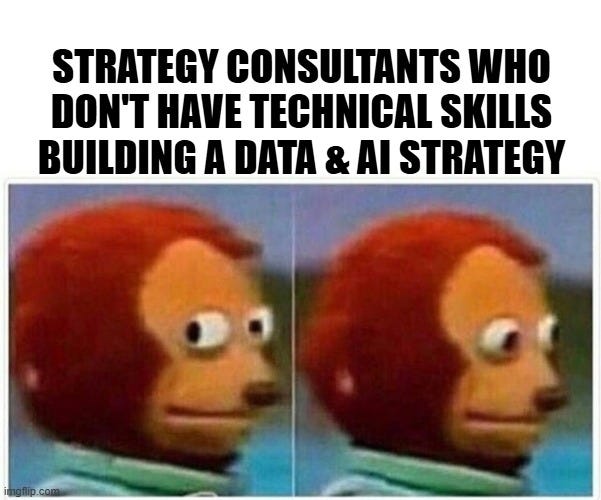
Then you will have the aspirational strategy, usually built by strategy consultants who understand the business but don’t get the technical realities. These strategies are great for the executive who wants to achieve a certain ROI or drive toward a specific value, but they don’t actually deliver on what they promise. It’s where people stop trusting data strategies and the data team to deliver on what is asked.
The worst version is an isolated strategy, developed in isolation without the right stakeholder input. This can take the same format as both of the above, but it’s not the technical or the strategic elements that are the downfall. Instead, it's that the leader didn’t talk to anyone in the organization, and there’s no buy-in for what actually needs to be done. AKA it’s not executable.
I approach data strategy differently. I take a holistic, business-led approach that considers the organizational complexity across different business functions. But at the same time, I pair that up with the data and technology requirements from those stakeholders to ensure that what we are building is realistic and scalable.
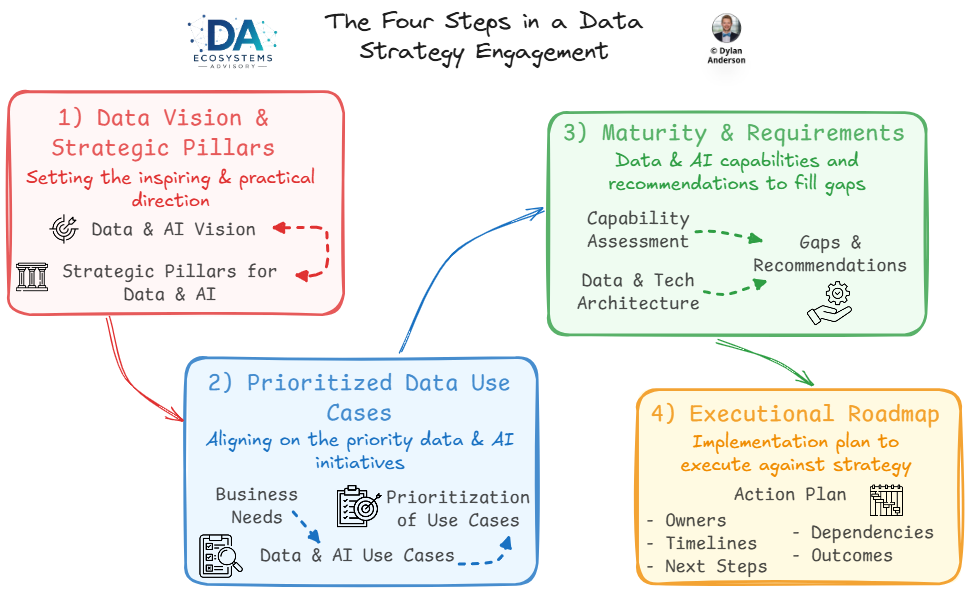
To do this, I approach data strategy in four components, taking that dualistic approach for each:
Data Vision and Strategic Pillars — Setting an inspiring yet practical direction that everybody is bought into
Prioritized Data Use Cases — Aligning data and AI initiatives to business needs
Maturity and Requirements — Assessing the organizational capabilities across data domains and recommending how to fill any gaps
Executional Roadmap — Creating realistic implementation plans with ownership, timelines, and clear next steps
In this article, we’ll dig deep into the first two, which tackle the direction of your data program. Next week, we’ll explore the implementation components of the second two.
Just remember this before we start: Direction without execution is just wishful thinking. Execution without direction is just an expensive activity. You need both, and any data and AI strategy should have both!
Understanding the Business and Data Context
Honestly, the biggest part of a data (and AI) strategy is making it relatable to the entire organization. You need people to understand why you’re building it and to be bought into what you are building.
The only way to really do that is to get the business and data context right.
There are four things you need to understand from existing documents, interviews and workshops with key stakeholders, or even a survey (if you want to go through that effort):
Business Model – As we’ve discussed before, understanding your business model and ensuring it aligns with and supports your data and AI goals is fundamental. How your business makes money, how it operates, and what its competitive advantage is all need to factor into data & AI priorities. Also, what industry-specific challenges and opportunities need to be understood?
Strategic Direction – The business strategy is obviously the next step. Figuring out what the executive’s top priorities or main strategic pillars are will ensure that data and AI are well-positioned to help achieve the organizational goals.
Business Performance Metrics – This aligns with the previous two, but it focuses on identifying the KPIs and targets that are the most important measures of success for the organization. In the end, if your strategy or initiatives don’t tie back to these things, they won’t get the investment they need.
Stakeholder Perspectives – And don’t forget about all the other challenges, pain points, and barriers to progress that exist in the organization. A data strategy is not just a top-down initiative; you need to make sure that all employees feel heard, and that you will do something about their problems as well, even if they aren’t the top priority (but funnily enough, those often become the top priority because so many people have those pain points).
These conversations are crucial for the success of your data strategy. Getting the business and data context from key stakeholders will make what you build tangible and realistic, rather than a laundry list of the coolest things you could do (which is what an AI-built data strategy would provide…).
After you have this context, the first thing to build is the data vision and strategic pillars to better articulate the direction you should head in as an organization.
Developing a Data Vision and Strategic Pillars
Every successful company has a strategic vision that is both inspiring and aligned with its direction.
With data and AI being so future-forward, getting the right vision to set the direction for initiatives is crucial. Moreover, that vision requires the right foundation to turn aspirational goals into reality.
So while I sometimes think the data vision strategic pillars component of a data strategy is a bit fluffy, it is also what brings everybody together and outlines the North Star that the organization is trying to get to.
What does an effective Data Vision look like? Simply put, it needs to be inspiring, achievable, and aligned with the organization’s strategy. It also should be built in coordination with key stakeholders in the business and on the executive team; you should see their language and ideas in the strategic direction.
Then the strategic pillars should cover both foundational data activities (infrastructure, technology, governance, data quality), value-added products (analytics, data science, AI), and enabling factors (culture, literacy, org structure/operating model). AI might make its way into all three of these things as well, given how everything is changing and evolving, but it is crucial to be specific about the role it needs to play in driving the data vision.
I also want to leave you with an example vision and strategic pillars. Let’s say this is a logistics company:
Vision: “Drive new revenue streams, provide exceptional customer service and streamline operations by building world-leading data & AI capability grounded in robust technical foundations, trusted & accessible data and an insights-led data & AI culture.”
Strategic Pillars:
Pillar 1: World-leading Data & AI Capability — Drive change in the organization to rethink how it operates, using AI as a strategic advantage and sharing the benefits of automation and better decision-making to customers, suppliers and partners.
Pillar 2: Strong Technical Foundations — Build a robust, trustworthy data infrastructure that serves as the bedrock for all data activities, with all tooling decisions supporting the overall organizational strategy and cementing a future-forward approach to AI enablement.
Pillar 3: Trusted & Accessible Data — Ensure data quality, governance, and accessibility are implicit in how we work as an organization, giving business stakeholders trust in our data, the decisions it drives, and the AI tooling becoming embedded in our workflows.
Pillar 4: Insights-Led Data & AI Team — Develop comprehensive data & AI tools that provide actionable insights to business stakeholders—enabling better customer service and operations—while helping foster an organization-wide culture of insight-driven thinking.
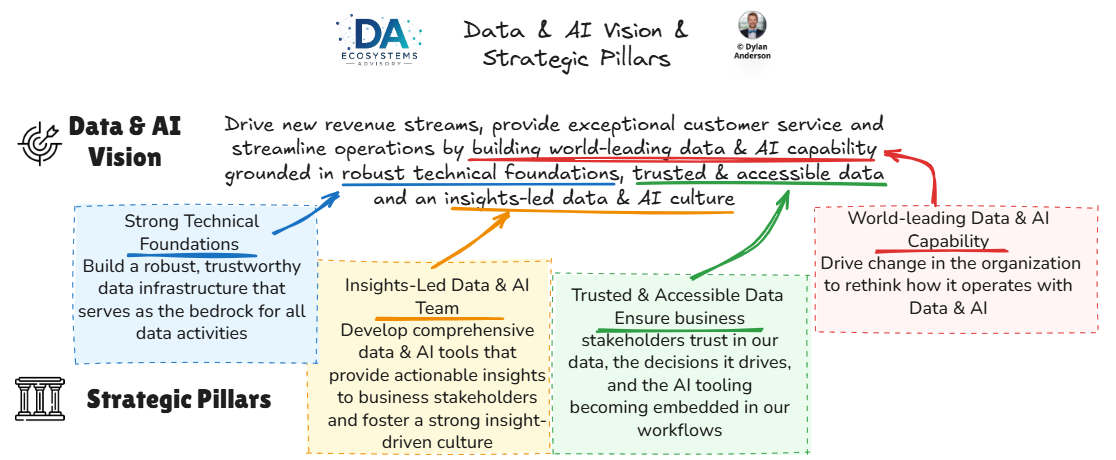
In the end, the goal is to have something that both business and data stakeholders are bought into, with 3-5 key focus areas to help get there.
Identifying and Prioritizing Data & AI Use Cases
Three years ago, use cases were all the rage; everyone said you had to take a use-case approach to building your data and AI foundations. And they were right. This is where your strategy starts to get real. Use cases are the specific initiatives that will deliver your data vision and support your strategic pillars.
However, use cases often turn into a wish list of cool data and AI products that the business and data teams wish they had. They don’t always consider the steps or foundational components that need to go into it. Moreover, when most people go to search for use cases, they often ask, “How do you use data? Or what kind of data products do you want?”
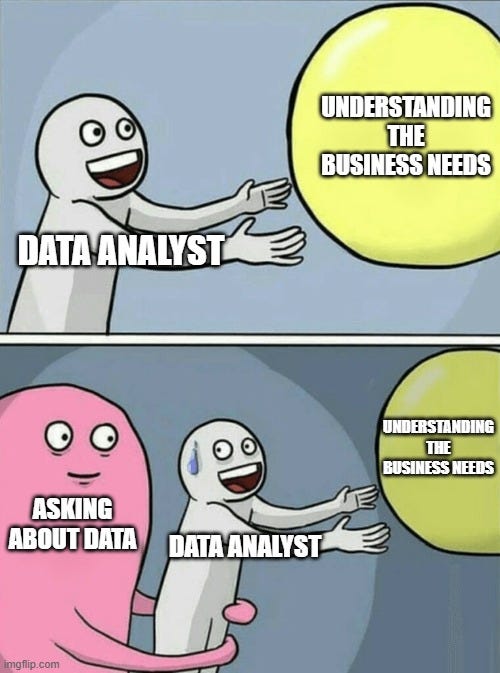
And this is where data strategies start to go nowhere real fast because you’re not really developing the foundations for something that you can tangibly build. You’re talking about ideas that someone has on their wish list, not about bridging the gap between technically feasible and business-critical.
We will do a whole article on use cases (and we have done one in the past on identifying stakeholder business needs), but the key point is: when you are interviewing stakeholders, try not to focus only on what data or AI can do for them. Instead, probe into what they’re trying to achieve in their jobs, what decisions they struggle with, and what would make them more effective.
That is their area of expertise and where they can offer the most insight. Then you as the data expert can put two and two together to figure out what to build and how it fits into the strategy.
After you’ve built this list of use cases with your business and data stakeholders, there are three more things to think about:
Outlining the Details – Work from a template to identify the business problem being solved, expected business outcomes, key stakeholders and users, success metrics, and a high-level approach to delivering it
Categorizing the Use Cases – There are two components to categorization. The first component is determining whether the use case is more foundational (e.g., data quality, standardizing KPIs, data governance) or value-generating (e.g., a data analytics or science tool). The first are necessary investments into your data estate and the second are directly linked with business outcomes that can measure ROI. The second component is categorizing by business function or data domain. So, for example, having multiple marketing use cases in the same category. This helps because data and AI use cases often compound and have prerequisites, rather than jumping to the coolest thing first.
Prioritizing Use Cases – Finally, it’s important to determine what is long-term versus what is a quick win. You can prioritize use cases based on:
Business impact or value delivered
Technical feasibility
Resourcing requirements
Dependencies
My belief is that when prioritizing use cases, you should ensure you have two to three quick wins you can start on right away, while delivering on one to two big, longer-term strategy priorities. This is all while keeping the foundational versus value-focused categorization in mind.
Setting the Foundation for Execution
A lot of companies don’t build a data strategy because it’s not execution first. And I’d partially agree with that mindset; you need to make sure you get something tangible out of any data strategy.
But these organizations also forget that, without this kind of direction, their teams often get lost in execution. The vision, pillars, and prioritized use cases you develop in this phase become the foundation for everything that follows.
And what follows is the next step of a data strategy: the Capability Assessment and Operational Roadmap. This is what we will cover in next week’s Part 2 article.
And with both together, you should have a clear brief to build your own Data Strategy (or at least a bit more clarity on how to do it).
Thanks for the read! Comment below and share the newsletter if you think it’s relevant! Feel free to also follow me on Substack, LinkedIn, and Medium, or reach out if you are looking for some top-notch consulting work in the Data & AI space! See you amazing folks next week!
This is GREAT information and a lot to digest!😃 My organization is finally jumping on board with having a data informed culture across the organization and not just in one siloed area. To gain more insight behind business strategy that helps to build a data strategy and eventually pulls in a IT strategy, do you have webinars breaking all of this down? Also, do you speak at virtual meetings? I lead an international data governance group and would love to have you speak on Data strategy. Great stuff!