

Issue #59 – The Modern Approach to AI Strategy
Why you need to rethink about strategy when it comes to AI

Read Time: 12 minutes
Since finishing the data strategy series, I’ve been thinking about how to follow up when it comes to AI.
Because I’ve built AI strategies before. But today’s world is different, and honestly, how I would approach it today is significantly different from how I would have approached it a year ago.
For the past decade, building a strategy has followed roughly the same rhythm. You interview stakeholders, set a direction, prioritize initiatives, build a roadmap, and then deliver against it.
And I would still contend that enterprise data strategies should be developed with this in mind, as I wrote in the past two articles (Issues #57 and #58). For this kind of work, you still need a foundational direction grounded in the organization’s intertwined realities; then you need to execute with a realistic plan.
But AI—in today’s world—breaks that sequence. Why? Because it is constantly changing and can be delivered at pace without a long transformational program.
AI strategy is the first strategy you have to build while it’s being executed.

That’s a different muscle than most leadership teams have built, and it’s where this article is going to spend its time.
Why AI Strategy Breaks the Old Playbook
The classic strategy model is sequential. You write the document, align the organization around it, and execute against it over a 12- to 24-month horizon.
This is how I’ve done it countless times before and how most consultancies approach it.
And honestly, for an enterprise-wide strategy, like data or a full business strategy, this is still very relevant because the most important thing you need is buy-in and perspective from across the organization. Not to mention organizing the relevant team to set the direction and execute the work. Therefore, taking the time helps with change management.
But AI isn’t going to wait a full year for change management, and it doesn’t sit within a singular team. It spans all teams, who are expected to figure it out ASAP.
Everybody is using AI to some degree, from the marketing analyst drafting customer briefs to the finance manager using embedded Copilot in their Excel to the legal team summarizing contracts. None of these tasks is on a roadmap. None of it is governed. None of it is showing up in a strategy deck. But all of it is happening at a scale and a speed that no central programme can catch up with.
This is what I mean when I say strategy and execution have collapsed into the same moment. With AI moving so fast and the ability for individuals to implement immediately, you can’t separate the strategic exercise from the execution if you want to see success.
But I should be clear: that doesn’t mean buy tools and start to invest without thinking of the strategic implications of AI and what that takes for your organization.
Also, this only works if you have business strategy clarity, and at the very least, a baseline data strategy. Without those underneath, AI will fall in on itself; you need that organizational direction.
Four Directions to Point AI Strategy
In the data strategy, we discussed developing a vision and strategic pillars, followed by relevant use cases. For an AI strategy, I would also recommend developing a directional vision or North Star. It will likely fold into your data strategy vision for the overall organizational direction.
When it comes to use cases, I want to identify four directions you can and should take across your different AI initiatives, which encompass a dualistic strategic and executional approach.
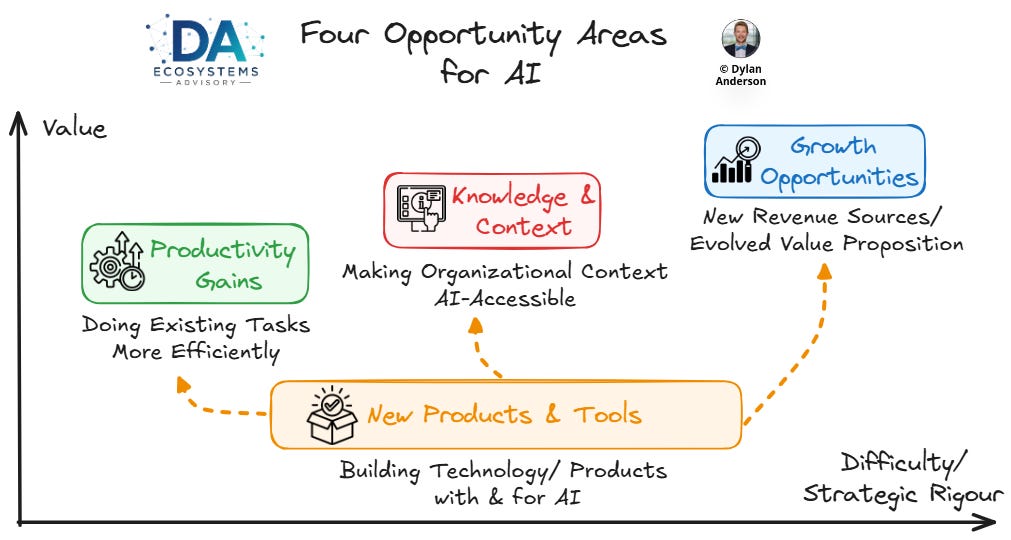
And to be clear, what makes this important is the deliberate choice of where to invest and where to focus your resources and time. Because despite the hype, you can’t build everything in a weekend with AI...
Productivity – This is the obvious starting point for AI. Companies have been applauding AI’s productivity gains for the last couple of years, justifying continued layoffs. It started with individual subscriptions to GenAI chatbots, and now it’s all about embedded AI doing your job for you. It’s the easiest direction to point to because the use cases are obvious and people are already doing it. It’s also the direction with the lowest differentiation. Every competitor is doing the same thing, and the uplift you get is mostly individual, though if approached strategically with proper training and resources, the scale can be enterprise-wide.
Knowledge and context – This is the biggest opportunity (and gap) most companies are identifying right now. Most organizations have fragmented data, context and documentation scattered across SharePoint, Confluence, Slack, email archives, and in people’s heads. People are starting to get executional in this area, plugging in their Claude Cowork or ChatGPT with existing files, databases, and tools. The problem is that the output reflects the poorly modelled, low-quality data fed into it. And this is where the strategic lens needs to be taken into consideration. Figuring out where your institutional knowledge lives and how to make it AI-accessible without exposing sensitive information is a crucial step in any organization’s AI journey, but it requires a strategic approach. Lucky for you, I’m going to spend a whole article on this next week.
Growth opportunities – Now we are trending towards the more esoteric opportunities in AI, and the ones that definitely require strategic thinking. This category goes back to the question of what AI does to your business model: think new revenue sources or an evolved value proposition. These may arise because AI can do something your team couldn’t do before, or do something that wasn’t economical before. Growth is where the upside is largest, but it takes the most discipline to realize what will get you there (and to stick with it rather than just chasing short-term gains). And to be honest, most companies will not get here because they’re stuck in the productivity bucket.
New products and tools – This area often overlaps with others, so it may be a secondary consideration. At the same time, AI app-building tools allow for a quicker dev cycle. I’m not saying rebuild your website via AI, but there are companies refactoring their baseline codebase in Rust because it is faster, building new data products with Claude Code or Lovable, or just adding on niche tools to their existing SaaS stack. This area kind of raises the build vs. buy question; it makes you reflect on which new products or tools to acquire in this new world of AI (rather than debating an RFP for 3 months and then taking 3 months to put one out).
The angle I want you to take from this section is to reflect, as an organization, on how AI fits into your strategy and where you want to go. It really shouldn’t all be about productivity, despite the headlines. And you need to maintain a strategic lens on these categories, ensuring focus on what matters. Otherwise, AI—and the unlimited possibilities it offers—will be more of a headache than a timesaver.
The Underpinning Layer
I’ve already written about the underpinning foundations of AI. As you go off and build, you need to consider the enablers of scalable AI: technology, governance, culture, and process redesign. These are all covered in my article on the AI Sociotechnical Operating System.
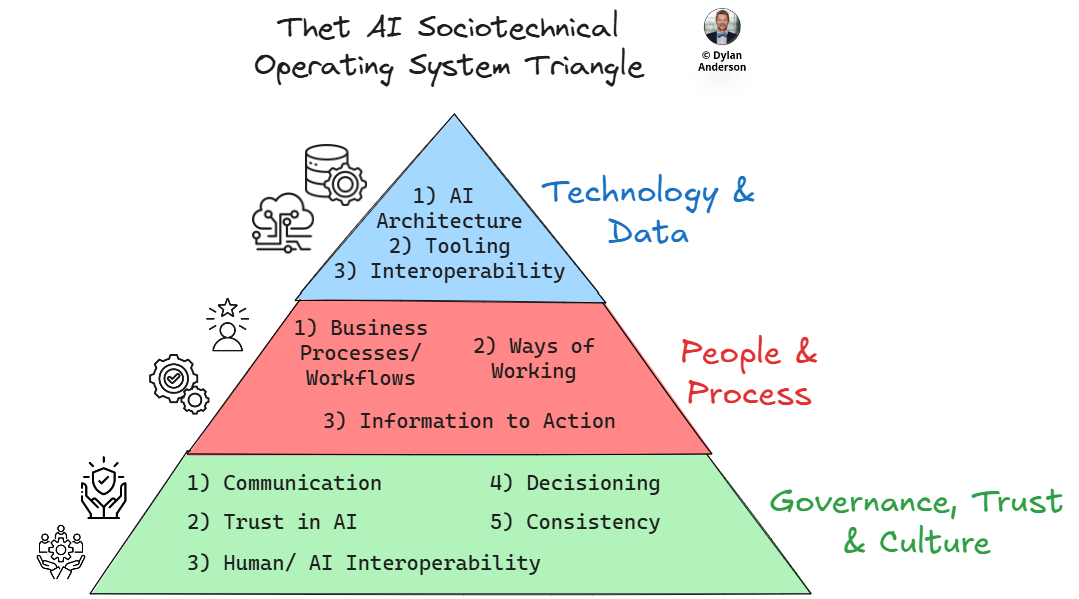
For reference, no AI strategy or company-wide initiative will work without considering how these three layers operate beneath it. The companies that thought about governance, built AI-enabled workflows, or invested in technology aligned with their organization’s needs are the ones that will succeed. The ones who ignore these things are going to be trapped in a feeling of “why isn’t this working?”
The Two-Track Execution Model
Alright, so we’ve outlined the different opportunity areas for AI, and briefly covered the AI Sociotechnical Operating System (slash you’ve read my article on it or pretended to).

Now, time for the strategy; and this is where AI strategy genuinely differs from every other kind of strategy I’ve built.
As I’ve mentioned before, strategy is usually delivered on a single track, with extensive discovery, cross-team engagement and a future-forward roadmap that leads into a change management/ transformation program.
With everybody using AI, you can’t wait for the change management. Your roadmap will naturally move at the speed of your workforce, whether they love vibe-coding new apps or are just figuring out what Agentic AI means. Execution is happening whether you like it or not. What most companies are forgetting is that a strategy is still necessary to direct execution. Hence, the two-track model.
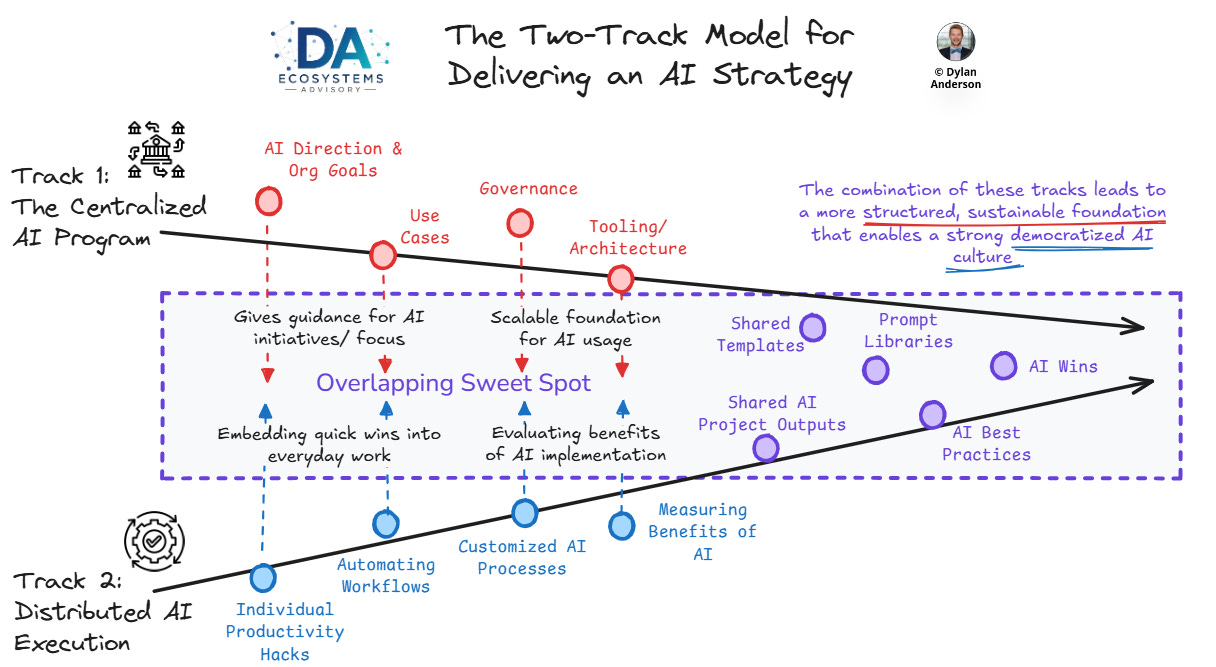
Track 1 — The Centralized AI Program
I want to start with the strategic first, because I don’t want to dismiss its importance.
There needs to be a centrally-led layer. This draws from your classic strategy playbook: organizational vision/direction, use cases, approved tooling/architecture, helpful tools (e.g., shared templates, prompt libraries), cultural enablers, a governance program, etc.
These artifacts ensure that any AI rollout is sustained, scalable and delivers on the organizational goals. I’ve seen a lot of companies just sign up for Claude Cowork and the AI debt they are incurring is staggering. A central track creates consistency (through governance or shared templates/prompts) in how AI is used, which helps people who may not be as technically advanced. Not to mention, you mitigate the common risk of having 23 different AI tools, one for each department, which adds cost and confusion.
Moreover, there are (or should be) initiatives that need to be planned and thought through, like organizing enterprise knowledge/ context, or building AI-enabled BI tools on top of a strong data foundation. As I mentioned above, these are the biggest value-add areas AI can provide to organizations, but they need to be thought out and centrally supported. In that sense, a documented, centrally-led AI Strategy is crucial.
Track 2 — Distributed AI Execution
But as the centralized strategic track develops the plan, the workforce-led execution track should test and implement AI.
Let’s be real, it is going to happen anyway. Most white-collar employees are using AI in their day-to-day work, even if it is just a chatbot. They are learning what works for them in their own workflows and processes, and nobody will wait for the AI Strategy to catch up. And learning by doing is the only way you are really going to get comfortable with AI (I can attest to this from my own evolution with it).
The strategic work in Track 1 needs to enable these activities and create the conditions for them to compound. Providing permission to experiment; helping distil the most value-add workflows to use AI in; giving a clear list of what’s off-limits; investing in tooling that matches how people actually want to work; or creating a way for employees to share what’s working.
With that foundation, people can start building and embedding AI into their workflows. Productivity tools like meeting summaries, email drafting, or automated to do lists. Customized processes to do analysis, create legal documents/ contracts, or build brand-aligned marketing content. Enabling these kind of workflows with AI isn’t hard anymore, and most people can do them with a little bit of guidance and a few tokens. This helps build AI culture, delivering measurable outcomes from the AI strategy within weeks rather than months or years.
The point of running both at once is that they feed each other. The executional track surfaces what actually works in practice; the strategic track turns those patterns into infrastructure so they compound.
Or in more classic corporate speak: bottom-up initiatives surface the valuable pieces, top-down support helps it scale. Figuring out the right feedback loop is the new version of strategy.
Hence, neither track works on its own in today’s AI-enabled age.
If you rely on distributed AI, you get chaos and risk. A lot of companies are running like this right now, with unfettered AI usage, no compounding benefits (largely individual-based), no line of sight to productivity wins, and lax security.
If you only run the centralized track, you risk falling behind and never catching up. Throwing bureaucracy and red tape in front of your AI goals basically guarantees that employees will work around the organizational guardrails and learn on their own. Not to mention, it will take ages to get something done, which ends up being way behind where the market is. This is not how you build an AI culture.
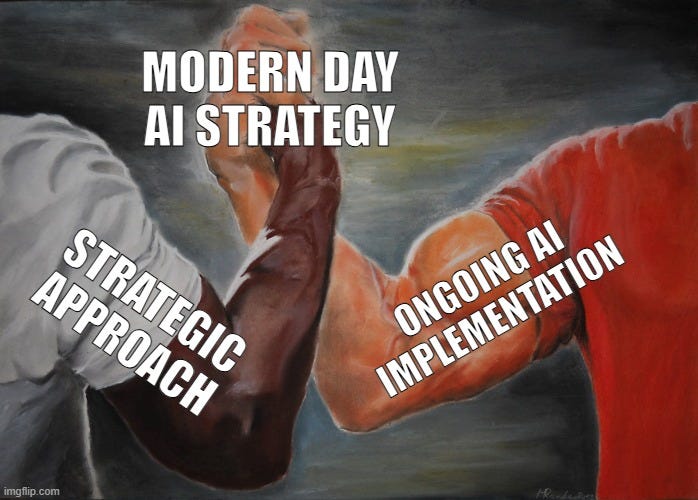
When you have both feeding into one another in the right way, the two tracks compound. The centralized, strategic approach gives the organization direction, governance, and the platforms that allow AI to scale safely and effectively. The distributed layer bolsters ongoing strategic initiatives with real-time data on what’s working, what’s not, and where to invest next. Not to mention, employees getting practical experience with AI as you scale.
This is a new world of strategy, and one that doesn't fit the bureaucracy of large consulting firms. You need individual experts who can guide you through it, or a dedicated internal resource who can enable it on an ongoing basis.
Your AI Strategy & Approach
What does all this mean for you and your organization?
Based on my consulting experience, I’d estimate that 70% of companies are going through this thought process right now. Maybe 20% don’t need to really evolve for AI, 5% are completely oblivious, and 5% already have a half-decent path to success with AI (yes it is that small).
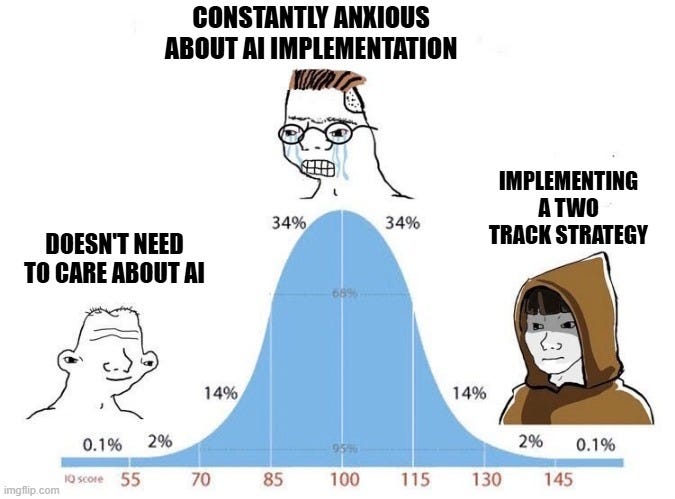
So the first thing is to know that you are not behind. Even an expensive, Accenture-stamped AI strategy from a year ago is likely outdated right now, so everybody is going through it.
Take three actions instead.
Recalibrate where AI fits in your strategy — Take the four directional areas (Productivity, Knowledge & Context, Growth Opportunities, New Products & Tools) and map where you are today versus where you should be. For most companies, the answer is probably limited to productivity. Think beyond that, and figure out which of the other three directions actually matters for your business’s success.
Structure the two-track approach inside your operations — Decide explicitly who owns the centralized programme and who is enabling the distributed execution. Both tracks need named owners, clear goals, and a defined feedback loop between them. How you structure this is crucial, as the two need to work symbiotically to be successful.
Document the wins and ship the proof points — The whole point of running both tracks is that you get measurable outcomes in weeks, not months or years. This allows you to capture the wins as they happen and share them widely inside the organization. These proof points add credibility and help build momentum, establishing an AI culture or justifying additional investment. And please don’t delay; AI is only going to get more relevant, and if you haven’t started thinking about this, your business can’t afford for you to wait another year or two.
Not a plug, but I’m doing this with one CPG client right now, developing a team-wide approach to implementing Claude Cowork and developing customized processes. This is happening alongside more formal conversations around governance, knowledge, and future AI products, all of which is having a huge impact. Before, even heavy AI users were scrambling and making errors all over the place. Now they at least have a strong foundation to execute on, while knowing how to start thinking about the long-term strategic pieces that they know need to come.
Next week, I’m going to break down the second of those four directional areas, the one I think most companies see the benefit of, but have no idea where to start. Yes, I’m talking about knowledge; more specifically, the Context Layer. This is all about the current issues with fragmented data/ knowledge, how to bring it together and make it AI-accessible for your agents, and best practices for doing so.
Until then, have a great Sunday! And if you’re in the middle of thinking about AI strategy and can’t figure out your next step, feel free to shoot me a message.
Thanks for the read! Comment below and share the newsletter if you think it’s relevant! Feel free to also follow me on Substack, LinkedIn, and Medium, or reach out if you are looking for some top-notch freelance consulting input! See you amazing folks next week!
In my experience, a key element of data processing/IT/AI strategy that is consistently overlooked is that of local customization. I estimate that over half of the reports produced by systems my clients use are presented to the users in MS Excel format. I’m not aware of any users who apply quality checks to the data that eventually emerges to guide management decisions, but I’ve often needed to deal with data values that seem to emerge from some alternate universe.
In working with AI, where outputs may be subjected to different processing sequences and changing source data selection, the issue of data quality could be even thornier than it is today.
My feeling is that any data processing strategy that does not incorporate observability at multiple points in the processes that retrieve, reformat, compute, consolidate and report that data in a form that will support reliable arguments that influence decisions, is introducing a non-quantified risk factor in the overall scheme.
However, enforcing standardization at the desktop level is probably a pipe dream.