


Read time: 8 minutes
Last week I wrote about what keeps data leaders up at night.
Honestly, it was kind of depressing, reminding me of all the challenges data teams and leaders face in today’s crazy world.
But I felt a bit better writing this piece—what excites data leaders!
Because honestly, despite the hype, the exhaustion of keeping up, and the unrealistic expectations, this is probably the most exciting time to be a data person in history!
So much is going on in the space of AI, allowing us to do more with what we have. And this is true no matter what data domain you work in, from governance to engineering to analytics. Yes, there is a lot of pressure, but with pressure comes diamonds (I’m sorry, I had to).
However, this piece is not going to read like a hyped up YouTube video or a clickbait news article. Nope, this is going to be about the tangible gains that excite data leaders; the things you don’t hear about often but that actually deliver value in an uncertain industry.
So, building on last week’s piece on anxieties (and pre-empting next week’s best practice data leader lessons), I present the findings from the Data Leader Therapy sessions on What Excites Data Leaders in Today’s World of AI!
This article & newsletter is free, which means passing it on is the only way it grows. If it was useful to you, it’s probably useful to someone on your team.
The Hype vs. Value Gap
SaaS vendors have bigger budgets than thought leaders or practitioners.
So the biggest things you will hear about AI and agents will probably have some sort of marketing spin on it. I mean, if you spent any time at an AI conference in the past year or two, you probably figured every data leader wanted (and potentially had) autonomous AI agents built on perfectly demoed RAG pipelines or context brought to you by the latest AI-enabled tool.
Honestly, that isn’t what I heard when I sat down with these individuals. I wasn’t necessarily expecting to hear about all the marketing fluff I mentioned before, but I didn’t expect how little the agent talk surfaced.
Granted, that was a year ago, but it told the story of how, in large organizations, there are so many foundational things to cover first. So can data leaders realistically think about next-gen technology?
Now they are more receptive to the conversation, especially as the frontier models and tech has improved. Those things are genuinely exciting, and leaders want those embedded in how they work. But this type of thing is not about what you want, it is about what will move the needle, what will work? In the end, leaders were more excited about AI helping build on what they already had/ what they were already working on. Things like improving their backend data quality or their BI tooling.
And even though that sounds less glamorous than the hype of AI agents, it is also why their teams are now the ones able to put agents to work. Having caught up with a number of them, they have been able to start spinning up AI agents in a way that is scalable in production, rather than just a demo/ POC.
This is the thread/ overall grounding of this article. When I ran these interviews, agentic AI was still figuring itself out. Now it is starting to work, but the more useful takeaway is that these leaders were excited about the opportunity for AI to build the foundations that agents would later need.
And now as a lot of less mature companies/ non-data stakeholders are running up to the ceiling of agentic AI, this is where the AI world is turning their attention.
Opportunity #1: AI To Fix Foundations
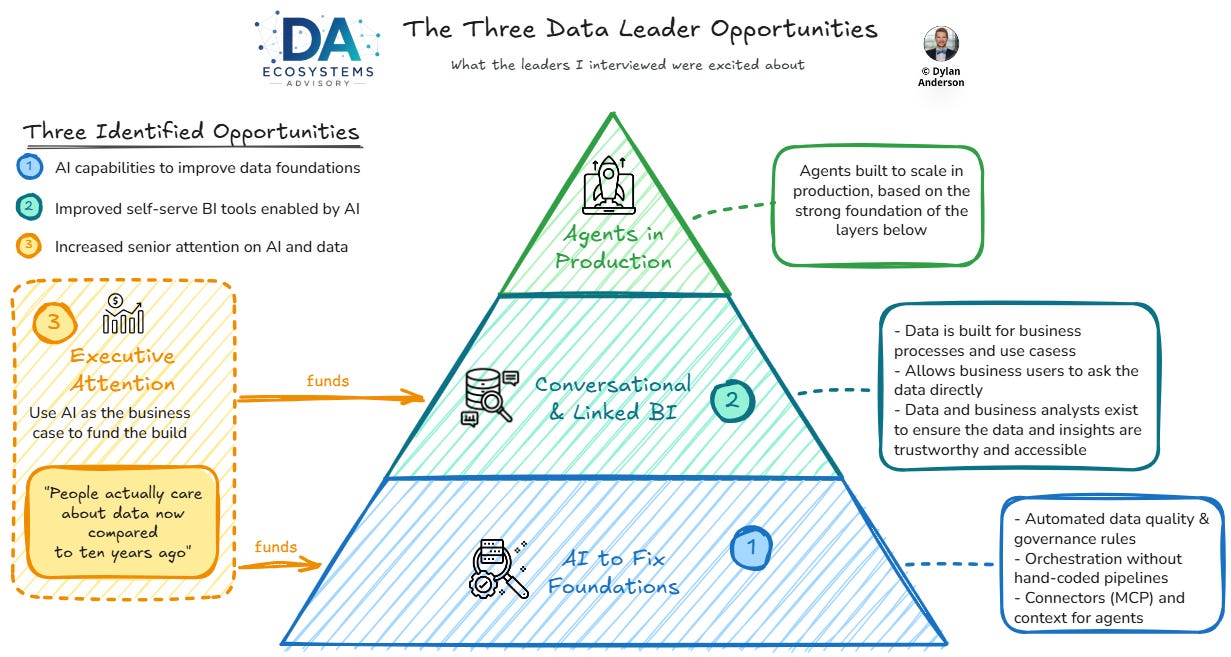
Despite the hype about analytics, business intelligence, and data science, the single most-cited opportunity was not customer-facing. Rather, data leaders were excited about the backend foundations and how AI could help improve those.
If done right (and everybody is hoping things go well), there are some clear benefits AI can have for data foundations that solve some obvious and never-ending challenges:
Improve ongoing quality without manual intervention – “Automated data governance and quality. AI’s ability to pull out patterns to tell you what is happening with the data.”
Reducing time spent in the IDE creating new pipelines or workarounds: “I’m so excited about bypassing Airflow and Python coding with new orchestration platforms. We are getting to the point with smarter platforms that you can save so much time from pipelines.”
This one we have seen appear over the last year with the MCP and connectors from frontier models
Backend data foundations that have improved non-technical access – “The overarching concept of having an enterprise data warehouse that any user can speak with in a human way”
These leaders understood that to deliver the biggest benefit, the biggest gains for AI would have to come in the things that took the most time. Wins like the above-mentioned compound and scale; no matter what you want to do with AI in the future, these opportunities are relevant.
And funnily enough, this is where we are starting to see the market move. Data quality tools are all about automated rules and governance. Every technology has an MCP option or connector to Claude Code or Codex, making data more accessible. And don’t forget context, since every company now seems to be talking about how they enable it.
All these things are foundational pieces that AI can help with and that analytical, business-facing agents need to stand on. Otherwise, AI will just produce hallucinations, and stakeholders will get the wrong answer.
Opportunity #2: Conversational & Linked BI
The second thing leaders kept returning to was the possibilities with directly accessible analytics. This has made huge strides in the past year!
Any data leader (whether that is data science, analytics, engineering, etc.) dreams of making data directly accessible to end business users in the way they want, without the ton of work, time, and maintenance that usually comes with it. I mean these two quotes summarize it perfectly:
“Better AI interpretation will help us bridge the gap between analysts and business stakeholders talking a different language.”
“If I fast forward, we need to have a huge shift from customized reports to more self-service.”
With analytical agents accelerating, this kind of reality is possible. Anthropic claims that Claude now handles 95% of internal analytics requests, taking a load off data teams.
Of course, that is Anthropic, and only a few companies are at that level of maturity, from their data foundations to architecture to AI fluency…
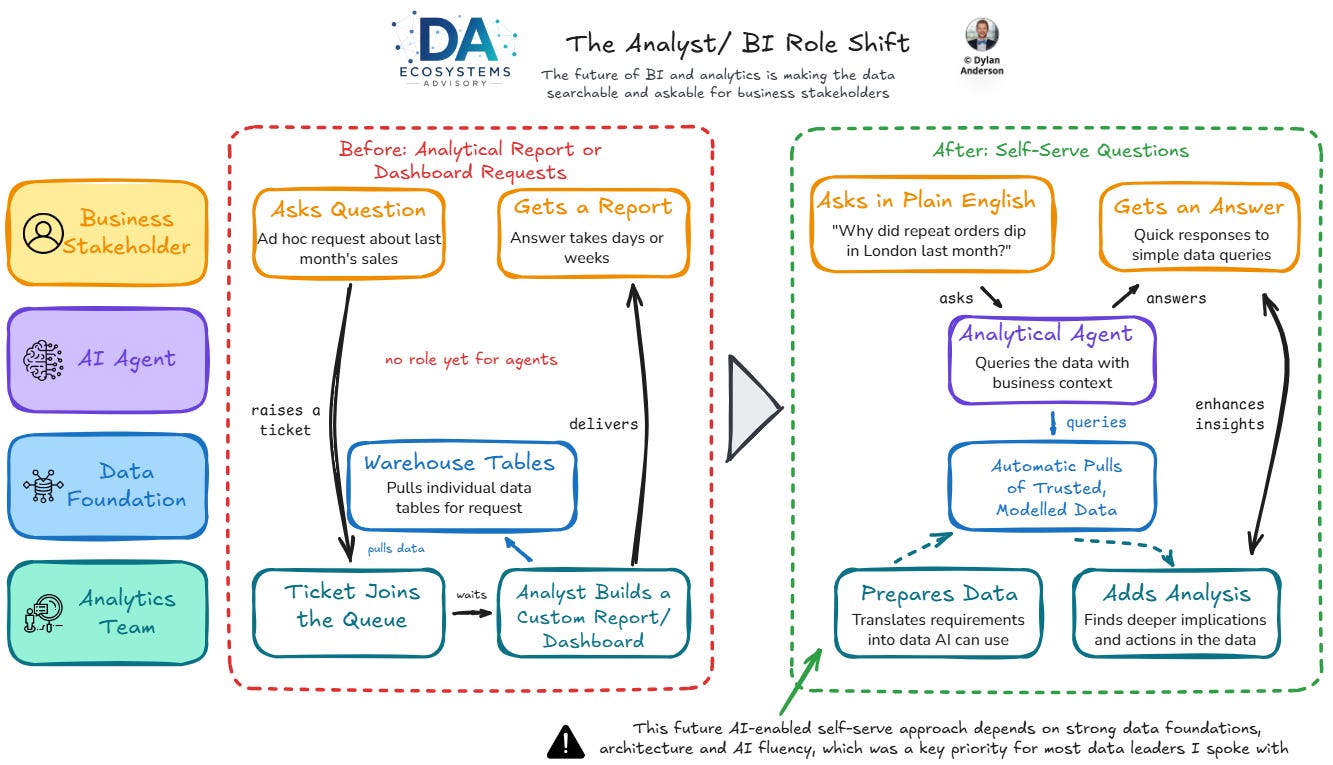
But this is the natural evolution of analytics; and what is crucial to understand here (from both the interview takeaways and what you are seeing in the market) is that analytical data becoming accessible via non-technical, natural language queries will become the new norm. And if business users can interrogate the data themselves, the analytics team stops being the people who build the dashboards and becomes the people who make the data trustworthy and reachable enough to be asked.
For leaders, this is also a mindset shift. The analyst role will still exist, but it will focus more on translating requirements into readily accessible data for AI tooling. This will require a different kind of data analyst who is still technical, but has strong soft skills like communication or problem-solving. Oh and btw, I created a whole LinkedIn Learning course on this shift if you are interested (not-so-subtle plug).
No matter how you split it, conversational and linked BI is the future, which is extremely exciting but will also require you, as a data professional or leader, to think a bit differently moving forward.
Opportunity #3: Executive Attention
The third opportunity has nothing to do with the technological side of data & AI. Rather, it frames up the political power data leaders can and should exercise in today’s evolving workplace.
As I described in last week’s article, the hardest part of a data leader’s job is often getting anyone to care and invest in the team, which links back to the poor brand problem. With AI that attention is becoming fixed on the data team. And since I interviewed these leaders, that obsession has only increased.
“People actually care about data now compared to ten years ago,” one leader said. “There is a very obvious and clear buy-in from leadership of every organization that data is everywhere now.”
While hype around data has happened before, AI has renewed it. And with that executives are paying attention and budgets/ investment have followed.
There is a catch, however. As the hype parade has continued on for so long, some executives are getting tired of the talk and want to see results. They are also hearing about agentic AI in other organizations, which means data leaders are now tied to certain expectations around AI. Finally, the first wave of embedded-AI failures and challenges is starting to circulate in companies (i.e., hallucinations in Claude, extremely high token costs, lack of organizational context, lack of non-technical adoption, and the realization that AI isn’t magic).
When I talked to these leaders, they used that renewed excitement to shore up their foundations and prepare the organization for AI, rather than blindly spending on new Agentic solutions or SaaS promises. That kind of opportunity is still open (think about all the Anthropic sign-ups in the past 6 months), but you need to justify the link to scalability.
As the hype peak starts to decline (per Gartner’s hype curve), using this executive excitement meaningfully will become increasingly important for data professionals and leaders.
How These Opportunities Fit Together
While it wasn’t obvious in an individual call, when you mixed together what these leaders were saying, it tells a pretty foolproof story for how to build and frame your data team:
Figure out the backend and foundation. AI can help accelerate that build and also act as a strong tool to help maintain data quality and management
Create widespread access to your data foundation in a way that business stakeholders can use the data while trusting it
Use AI as the business case to help build those first two components with your leadership team. Frame it in that way and you can help distinguish the business value your team can create, while AI is the buzzword that helps you sell (sorry but that is necessary in today’s world).
Embedded AI and agentic engineering have further enhanced these three opportunities. Data foundations was always about redesigning how the data team worked to fit the business model and its needs. That aligned with the three opportunities these data leaders outlined.
But now you should also re-architect those processes to be agentic-enabled, accelerating and improving how people work. Of course, that means refactoring how teams work and the training/support that comes with it (and there is a lot of that; every potential customer/client I talk to is stuck at this stage, especially with non-technical stakeholders).
If you take anything from this article, it should be that the successful data leaders I interviewed identified the opportunity to do AI well by focusing on the foundations.
If you skip them, you'll ship AI and agents on a foundation that hallucinates or fails in production. Remember when Klarna tried it (and publicly bragged about it), replacing the equivalent of 700 customer service agents with an AI assistant, and then admitting that the all-AI approach had produced lower-quality service and that it started rehiring humans. Even Gartner (who is always bullish on new technology) now predicts that half the companies that cut service staff because of AI will be rehiring by 2027. And now Meta and other top tech firms are rehiring their engineering managers they fired because AI isn’t a great manager…
While taking a foundations-first approach is important, don’t use it as an excuse to not ship anything. Now with AI, you should be strategizing, building and figuring out how to scale all at the same time. This is the time to fail fast, but recognize that failure must come with learning and progress in the core data domains. And it is worth remembering, your organization (if it isn’t super new and mature, so 95% of companies out there) has real tech debt, data silos, and business context that only lives in people’s heads, so you need to build with that in mind.
Speaking of, that is one area we will get into next time, in Part 3 of this Data Leader Therapy series. Here, we will focus on what the best data leaders do differently to make things operate effectively. Until then, have a great weekend and see you next Sunday!
Thanks for the read! Comment below and share the newsletter if you think it’s relevant! Feel free to also follow me on Substack, LinkedIn, and Medium, or reach out if you are looking for some top-notch freelance consulting input! See you amazing folks next week!
The shift from dashboard building to making data trustworthy and query-able is important. One practical risk is preserving business definitions when every stakeholder can ask the warehouse a slightly different version of the same question. I would treat governed metrics, traceable definitions and visible uncertainty as part of the analytical product, not merely backend preparation.
Did any of the leaders talk about business users asking questions they wouldn’t previously have sent to an analyst?